
YOUR INSIDER'S GUIDE
TO PROBLEM FREE FOREIGN LANGUAGE PRODUCTION
What Type of Media Production Project Do you Have?
Key Consideration #1: Media Project Assessment
When you receive a request from your client to translate their English media into another language or languages, it’s important to understand what you have and more importantly, to have a strategic game plan in place to ensure a smooth and successful outcome.
To get started, let’s address a few types of media production projects. There are 6 basic types of media production that we usually run into.
- Audio Only
- Audio for Video:
- Narration Style
- UN or Interpreter Style
- Lip Sync Style
• Subtitling
• Video Post Editing:
– OST: On Screen Text Graphics
– Foreign Language Image Graphics Localization
– Sound Effects
– Music
• E-Learning
• Power Point Audio
The type of project you have will determine which foreign language “production strategy” is needed to produce a high quality result.
What Production Strategy Do You Need?
There are as many ways to produce video and other media as there are talented and creative producers. Likewise, each media project will have its own set of unique challenges and considerations when converting them into foreign languages.
Good news: Several foreign language production strategies can be applied to design and deliver a great product. Any one or a combination of several styles could be used in a single project.
In this section we’ll go over the most common styles of production.
Let’s start with...
Audio for Video or “Dubbing”
The term dubbing can mean a few different things. But for our purposes foreign language dubbing is simply the process of replacing the English audio with a new target language audio track.
How the foreign language dubbing process would work with your video is one that has the language voice talent in a special designed recording booth. This person will be wearing headphones; which will allow the voice talent to hear not only their voice but also the original English voice that is part of the original video.
Why is this important?
The voice talent will be able to hear all of the nuances of the original English voice track. Including the speed of the voice, the tone, the inflections and any other characteristics that are important to help the voice talent stay faithful to the original English voice-over delivery.
This technique will allow us to produce a target language version that is very similar to the original English version.
With audio dubbing there are basically 3 types of production strategies:
1. Straight Narration Style
2. “UN” or Interpreter Style
3. Lip Synch or Complete Dialogue Replacement Style
Each style requires a different translation approach and production skills. There are cost differences between them as well. I will address the specifics of the translation side of this in another chapter.
1. Straight Narration:
In this style, no person is “On Camera”; audio is simply a narration over the video images. This production strategy is the most flexible style for matching timings and therefore the easiest to produce and least costly as well.
2. On Camera “UN” or “Interpreter” Style:
The acronym “UN” is derived from the interpreters that work for the United Nations.
With this strategy, the original language begins at full volume, and then fades under the target language voice.
You see this style on the news all the time when they interview someone from another country. Although it is a little more costly than the Narration Style, it is relatively easy to do.
But this style does have its challenges. Our goal is to END at the same time as the English voice so that we can stay in sync with the next section.
Suffice it to say, a well-adapted translation that communicates the full meaning in a shorter time, is essential.
3. On Camera “Lip Synch” Style:
With the Lip Synch Style, the original narration is completely replaced with the new target language. Done well, it appears as if the on-camera person is speaking the new language.
This is the most costly production choice because:
The translation has to be adapted to very tight tolerances.
The voice talent must deliver a great performance that matches the character, tone and inflections of the English audio... “in real time”.
The audio engineer needs to have advanced skills for quick editing on the fly to verify that each take is within tolerances for editing, which is the next step of our process.
This includes matching the pauses within each sentence throughout the video. This recording process takes generally two to three times as long to produce as either of the previous styles.
Why? Because each member of the language production team – the translator, bilingual producer, voice talent and audio engineer needs to be at the top of his/ her game in order to make the finished product look and sound great.
Here is a shortlist of requirements for a successful project:
- First, the translation must be adapted correctly for the required style or styles in the video script (more on this later)
- The voice talent must be native to the target country and speaking clearly with great diction
- They also must be able to record their language while listening to the English in their headphones in real-time... all the while taking in the nuances of the English voice’s Tone, Speed, inflections, etc.
- A native bilingual producer needs to be present at the recording sessions to assure accuracy of the script translation, voice over performance and any real-time translation adjustments if necessary
- The audio production company must be able to employ the best practices of the foreign language production strategies
- The audio engineer needs to have fast editing skills in order to determine if recorded takes are within the tolerances for audio post editing while keeping the recording session moving smoothly to avoid cost overruns.
Too see examples of what we’ve just discussed please use the link below to send me an email. I will send you the login credentials for this page. EMAIL ME HERE.
Audio Only Style:
This is the most basic audio project to work on. There are no timing restrictions; therefore the amount of time required to record the translated text is faster than audio for video.
Our experience shows us that our language voice talents are able to read, on average, around 2000 words in one hour.
2000 words equal’s a total run-time of around 13 minutes.
Video Post Editing:
For our purposes, Video “Post Editing” is a term that is associated with editing a video in some way after the original video has been completed. This type of editing usually comes in the form of “Text On Screen” that is part of most every video project, often times coinciding with the language audio production.
Some examples of post editing “on screen” text are:
- Titles cards of sections within the video
- Bullet points that coincide with the audio
- Symbols like arrows etc.
- General text that re-enforces or showcases what the audio saying
Subtitles are also a form of video post editing. I’ll address this in more detail in the next section.
When you receive a request for language video production, you should ask your client if on screen text graphics are needed in addition to the audio. Should they want you to provide the on screen text graphics, we would need the following:
- The original English video for reference
- A high quality English video without the English text on screen
- We would also like to have what is called “split audio”
Split audio is when the English narration is separate from any music, ambient background sound or sound effects.
Basically:
- The English narration should be it’s own audio file.
- The music should be it’s own audio file
(In some cases it would be fine if the music and background audio are combined into one file)
As far as the translation is concerned, on screen text graphic should “not” be part of the voice over script. Instead they should be a separate translated document
The important thing to consider here is the synergistic aspect of being able to produce the audio and video post editing at the same time.
Keeping the production with the same production studio assures that a cohesive checks and balance system is applied to the entire project not just the video portion.
Subtitling:
The second most popular option for video we see is subtitling. Subtitling, in certain situations, can be an effective way to communicate your client’s message. It’s important to note however that when producing subtitling for foreign languages, it’s critical that special attention is applied to the subtitle process.
Each language will have its own unique challenges and the subtitling process can vary depending on the conceptual style, speed of the English narration, and format of the video.
The art of subtitling in general requires a delicate balance of controlling the limited amount of text characters on screen, time they are on screen, and the average pacing or speed that each subtitle starts and stops.
The unfortunate reality of foreign language subtitling is that the translation can rarely be an exact word-for-word representation of the source video. If you remember our discussion about the Lip-Synch style regarding a colloquial approach to translation, it very much applies here as well... maybe even more so.
As a rule, the slower the speech, the closer a translated subtitle will resemble an actual source language. The faster the speech, the more creative a translator needs to be in order to provide the reader a pleasant reading experience.
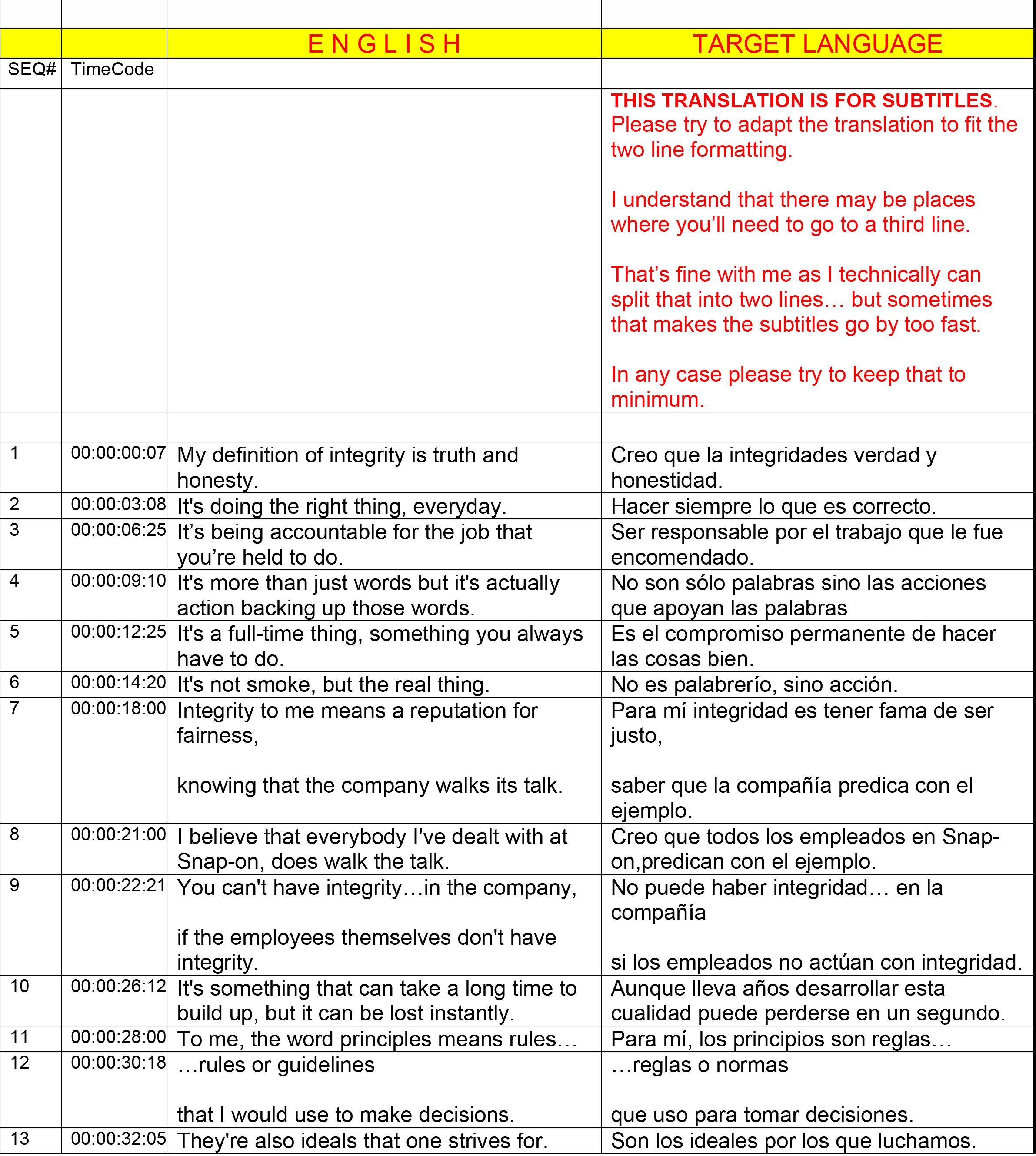
I highly recommend you let LRS Recording re-format the English script into a specific bilingual, 2-line, subtitle format.
The reasons are two fold.
1 This will give the translator a visual of how I need to subtitles to be split as well as help the translation stay within the parameters we would need.
2. The will guarantee that I receive the correct subtitle format to re-import to my professional subtitling software.
This will go a long way to avoid issues during production.
I have an example of what this formatted Word document would look like below.
If you have any questions please let me know and I’ll go through this in detail with you.
5. E-Learning: Audio Production
There are a number of software programs today that specialize in E-Learning such as Articulate, Captivate, Litmos, Docebo, TalentLMS, CourseMill, WiZDom Training, Schoolkeep etc.
From our perspective it doesn’t matter what software your client is using, our recording process is the same. The only thing we need to know is what the deliverable audio format would be.
E-Learning projects have the propensity to be very large, some spanning years of production,with updates annually.
Since E-Learning projects can have a long life cycle, consistency in the audio is very important. The audio engineer needs to make precise measurements and document each voice talent’s recording and mastering settings.
Why? If this is not done correctly the volume and sonic palette will change with each recording session and the user experience will be compromised. Also, it is best to hire voice talent that has the potential of being available for the annual or semi-annual updates throughout the projected life cycle of the project.
E-Learning projects not only will need audio but they also may need video as well. This would require the translation to be flexible so that it would match the production style.
Finally, translation requires time and great expense. Accuracy and attention to detail are paramount. Budgets for large projects can be quickly consumed without a solid production strategy.
POWER POINT PRESENTATIONS:
Power Point Presentations are very similar to the Audio Only style. There usually are not any timing restrictions.
Key Consideration #1 Take Away:
Successful planning prevents chaos.
At the onset of a project, assess how easily the media project will convert to other languages and address which production style is needed
Consider in advance:
-
√ What type of project do you have
-
√ What style of language production you need
-
√ Know that you’ll need to adjust the style of the translation to the language production style
The fact is...
It literally takes a small village of experienced professionals who can seamlessly work in concert with each other to turn an English video into a great foreign language product.We're very proud of our village. We believe they are the best in the business.
Please let me know if you have any question.
You can contact me at Info@lrsrecording or call me at: 312-399-7490.
~All the best
Mark Ohlsen
Founder of LRS Recording, LLCStudio: 312-294-0166
Email: info@lrsrecording.com
Skype: LRSARECORDING
Website: https://www.lrsrecording.com

